
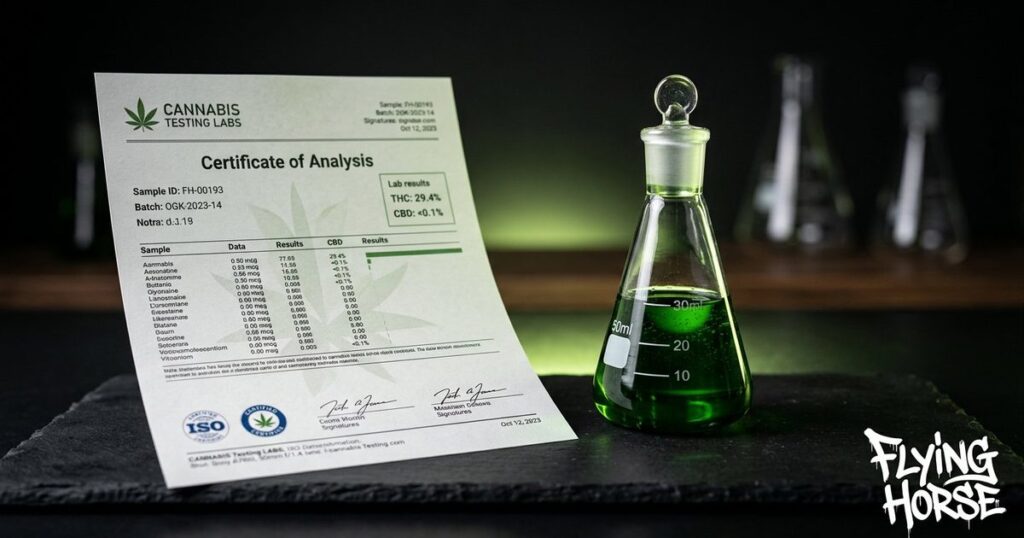
Plants are filters — they take up everything from the soil and the air, including the things you’d rather they didn’t. That’s why the “boring” panels on a COA (heavy metals, pesticides, microbials) exist: they’re the sourcing audit. A clean contaminants panel tells you more about how a brand operates than any marketing copy. Here’s what’s being looked for and why.
How Contamination Gets In
- Soil history. Cannabis is a known phytoremediator — it’s deliberately grown to pull heavy metals out of contaminated land. Grow hemp for cannabinoids on land with a mining, industrial, or legacy-agricultural history, and the plants do what they evolved to do: concentrate metals. Lead, arsenic, cadmium, and mercury are the watchlist.
- Water and nutrients. Irrigation sources and fertilizer inputs can contribute metals and pesticide residues.
- Pesticide use. In the unregulated hemp channel, some growers apply products (including ones with no food/cannabis-use label) to manage pests — and the residues ride into the finished product.
- Processing. Extraction and handling equipment can contribute metals (leaching from unlined equipment) — another reason the extract stage gets its own solvent and metal checks.
The Panels, and What “Clean” Looks Like
| Panel | What’s checked | What a clean result shows |
|---|---|---|
| Heavy metals | Lead, arsenic, cadmium, mercury, chromium | “ND” (not detected) or values far under action levels — e.g., lead well under 2.0 ppm for cannabis in the states that set limits |
| Pesticides | Multi-residue screen (dozens of compounds) | No detectable residues, or only trace levels of compounds well under limits |
| Microbials | Aerobic count, yeast & mold, E. coli, Salmonella, Staph aureus | Low counts, no pathogens — critical for edibles |
| Residual solvents | Ethanol, butane, IPA, hexane | At or near detection limits — clean extraction |
The specific numeric limits vary by state statute (where they exist) and by lab standard — the point for a buyer is the pattern: a brand with consistently clean panels across batches is operating with controlled sourcing; a brand with one perfect report and no others is operating with one data point.
Why This Is a Brand-Signal, Not Just a Safety-Check
- Metals don’t lie about process. You can market “premium” cheaply; you can’t market “premium” while sourcing from a mine-adjacent field. A clean metals panel is evidence of the supply chain, not a description of it.
- Pesticide screens reveal grow discipline. Consistently clean screens mean the grower is managing inputs, not just harvesting.
- The per-batch requirement is the tell. One clean panel is a snapshot. A per-batch program (published, batch-matchable — the Flying Horse lab reports page is structured exactly this way) means the supply chain is checked on every production run, which is what “quality control” actually means.
What to Do With a COA in Hand
- Read the six numbers in the COA reading guide — metals, pesticides, and microbials are numbers 4–6.
- Compare across several batches of the same product — consistency is the signal.
- Match the batch on your label to the report; if a brand can’t produce the COA for the batch you hold, that’s your answer to the quality question.
The full testing standard, and what fails get held: the testing guide. Product-specific results: every COA on the lab reports page.