
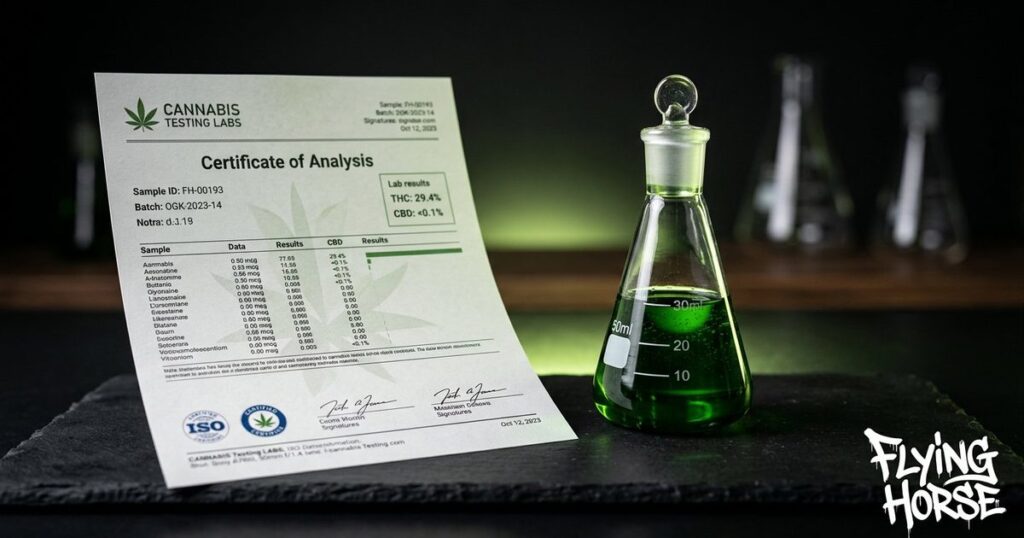
A certificate of analysis (COA) is the difference between a brand that measures its product and a brand that describes it. Most COAs look like a wall of numbers; six of them matter to you. Here’s the plain-English reading guide.
What a COA Is (and Isn’t)
A COA is a laboratory’s signed report on a specific batch of product: what was tested, how it was tested, what was found, and whether the findings fall within stated limits. It is batch-specific — a COA for “Lot FH-2609-14” says nothing about Lot FH-2609-15. That’s why batch codes on labels exist, and why a brand that publishes COAs per batch (like the Flying Horse lab reports page) is doing something most of the market doesn’t.
The Six Numbers That Matter
- The active cannabinoid (THCP, for this site). The headline potency number — e.g., “THCP: 78.4% of dry weight” for a distillate, or the per-piece/per-gram figure for finished product. Check: does it match the label claim within a reasonable margin (±10–20% is normal analytical variance)?
- Delta-9 THC. For hemp-channel product, this should be at or near the detection floor — the 0.3% compliance number is about the plant, but a finished product with meaningful delta-9 is a different (less legally comfortable) thing. You want this number low.
- Cannabinoid profile (THCA, CBD, CBN…). The full panel shows what else is in the extract. A clean THCP product is high-THCP with low noise; a “blend” will show multiple actives by design.
- Heavy metals (lead, arsenic, cadmium, mercury, chromium). These should read at or near the lab’s detection limits (“ND” = not detected, or a tiny number well under the action level). Cannabis concentrates are excellent at bioaccumulating metals from soil — this is the panel that catches sloppy sourcing.
- Microbials (total aerobic count, yeast & mold, E. coli, Salmonella, Staph aureus). You want “ND” or low counts and no pathogen presence. Edibles get extra scrutiny here — a COA for a gummy jar should show a clean microbials panel.
- Residual solvents (ethanol, butane, IPA, hexane) — for extracts. Should be at or near detection limits. Solvent residue is the classic “why does this taste like chemicals” answer.
What “Pass” Actually Means
- Pass against what? A COA’s “pass/fail” column references stated limits — which may be the state’s action levels, the lab’s defaults, or the brand’s own (possibly lax) internal spec. Read the limit column, not just the pass column.
- The lab matters. An ISO/IEC 17025-accredited lab with a track record is a different document than a random lab. The testing guide covers how to evaluate the lab itself.
- One batch ≠ every batch. A great COA for one lot is a promise about that lot; consistent COAs across lots is the actual quality signal.
How to Verify Your Batch (2 Minutes)
- Find the batch code on your label (ours: “LOT” + code).
- Go to the lab reports page and match it to the published COA.
- Check the six numbers above. If your batch isn’t listed, email [email protected] — a legitimate brand can produce the report for any batch it shipped.
Product pages state per-piece and per-device potency (lineup); the full testing standard is in the FAQ. And when a number doesn’t look right, that’s a support conversation, not a guessing game.