
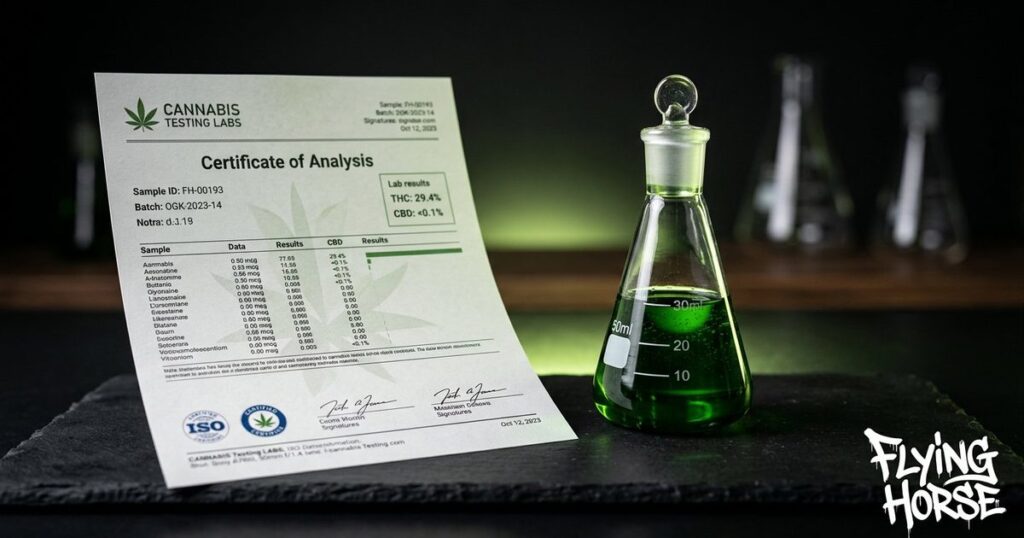
In an unregulated market, “quality” is a word until it’s a document. The only quality signal that separates a serious cannabinoid brand from a label printer is independent third-party testing — and the only way to tell the difference is knowing what to look for. Here’s the full picture.
Why “The Brand Tested It” Is Not a Quality Claim
A manufacturer testing its own product is grading its own homework. There’s no structural reason a brand’s in-house “QA report” should be believed over the marketing copy it sits next to — they’re produced by the same team, in the same interest. Third-party testing means a laboratory with no financial stake in the result, using accredited methods, reporting what it finds — including the bad numbers. The difference is the same as the difference between a company’s financials and an audit.
What a Real Third-Party Program Looks Like
- Accredited lab — ISO/IEC 17025 accreditation (the international standard for testing labs), or equivalent state-recognized status. The COA should name the lab, not just say “tested by a lab.”
- Per batch, not per product — every production lot gets tested before release. “We test our products” (vague, present tense) ≠ “every batch has a published COA” (specific, per lot).
- Full panel — cannabinoids (including the active isomer and delta-9), heavy metals, pesticides, microbials, and residual solvents for extracts. A one-number “THCP potency” report is a teaser, not a panel.
- Published and matchable — the COA is publicly available and the batch code on your label maps to it. If you can’t match your jar to a report, the testing is decoration.
- Fail-and-hold — a batch that fails any limit doesn’t ship. You’ll never see a failing COA published (it wasn’t sold) — but the discipline shows in consistent, clean reports across lots.
The Red Flags (Quality Claims to Discount)
- “Lab tested” with no lab named and no COA link. A claim, not a document.
- One COA per product line (the same report for every jar of that flavor). That’s a snapshot, not a program.
- Potency numbers that read like marketing — “100% THCP” or round-number perfection. Real analytical results have decimals and variance.
- “Batch tested” but no batch codes on packaging. Unmatchable testing is unverifiable testing.
- Testing only the thing that flatters the product — potency only, no contaminants. The contaminants panels are where sourcing failures show up.
How to Check Any Brand in 5 Minutes
- Find the COA page (or ask support for it — a real brand will produce it without friction).
- Confirm the lab name and accreditation.
- Match your product’s batch code to a report (how to read one).
- Check the six numbers: active cannabinoid, delta-9, profile, metals, microbials, solvents.
- Look at several lots, not one — consistency is the signal.
How Flying Horse Does It
Every production batch of every product on this site goes to an independent ISO/IEC 17025-accredited laboratory for the full panel before release, and the COA is published and batch-matchable on the lab reports page. It’s not a marketing feature — it’s the operating standard, and the about page covers how the testing sits inside the whole production process. Questions about a specific report: support will walk you through it line by line.