
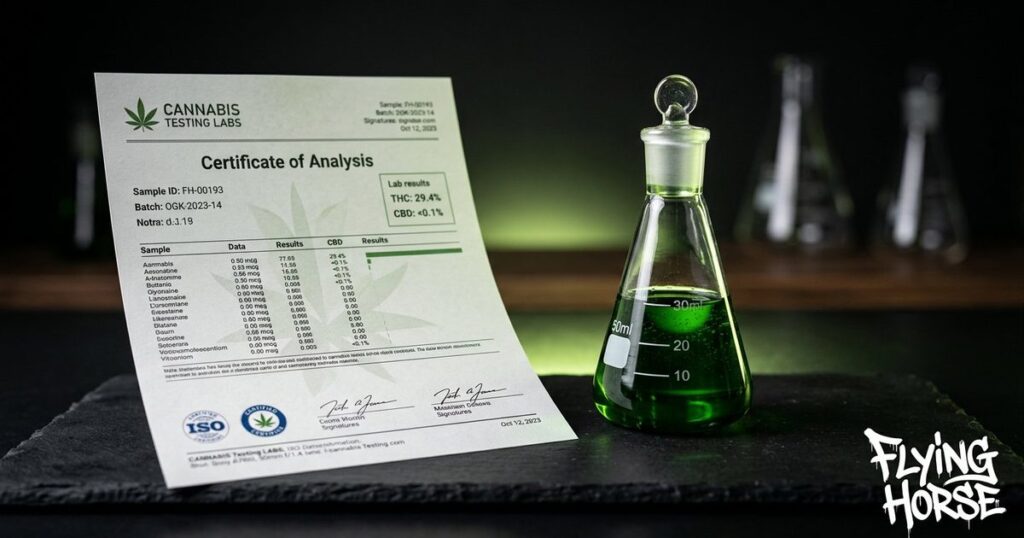
Most people can’t tell an untested THCP product from a tested one in the store (or the cart) — the labels look identical, and the untested ones are usually the ones with the bolder claims. This is the buyer’s checklist: ten red flags that separate measured product from label printing. If you see three or more, walk away.
The Ten Red Flags
- “Lab tested” with no lab named. A claim, not a document. A real brand names the lab on the COA — and the COA is publicly findable. No lab name = no test to point at.
- No COA link anywhere — not on the site, not on the label, not when asked. A brand that tests per batch can produce a report in minutes; friction is the tell. (Compare: the Flying Horse lab reports page is linked from every product page.)
- One COA for the whole product line. A single report covering “this flavor” (all jars, all weeks) is a snapshot posing as a program. Real testing is per batch, matchable to the code on your label (batch codes explained).
- Round, perfect potency numbers. “1000mg exact” or “100% THCP” reads like marketing. Real analytical results carry decimals and variance; a label with no margin language is a label that’s never looked at a COA.
- No batch code on the package. Unmatchable product is unverifiable product. If your jar can’t be traced to a report, the “quality” is a description, not a measurement.
- Potency-only testing (no contaminants panels). A COA showing only “THCP: 78%” and nothing on metals, pesticides, microbials, or solvents is a teaser. The contaminants panels are where sourcing failures show (why they exist).
- Price that defies the supply chain. Accredited per-batch full-panel testing costs real money per lot. A product priced below the cost of its own quality control is telling you where the money went — it didn’t go to the lab.
- Vague “natural terpenes” / no composition. Not a red flag by itself (some legitimate products are vague), but combined with #1–#3 it’s the sound of a fragrance cocktail filling space that a real extract spec would hold.
- Pressure tactics at the edge of legality. “This is the last batch before the law changes” is a sales line that works precisely because the buyer hasn’t checked the actual law. Check your state yourself (state map) — a legitimate brand’s shipping policy handles restricted states with cancellation and refund, not urgency theater (shipping policy).
- Support that can’t answer a batch question. The 30-second test: email a brand and ask “what’s the COA for batch X on my jar?” A real brand answers with a report or a specific date; an untested brand answers with a paragraph. (You can run this test on us — it’s a feature we rely on.)
The Clean Alternative (What “Passed” Looks Like)
- Named, accredited lab (ISO/IEC 17025) on every report.
- Per-batch full panels: cannabinoids and contaminants.
- Batch code on every package, matchable to a published COA.
- Potency claims that state per-piece mg and carry a margin of analytical variance.
- A support channel that answers the batch question in minutes.
That checklist is, deliberately, a description of how the Flying Horse lineup is built — the about page covers the production standard, and the testing guide covers why each element exists. Your next purchase, tested or not, is better made with this list in your back pocket.