
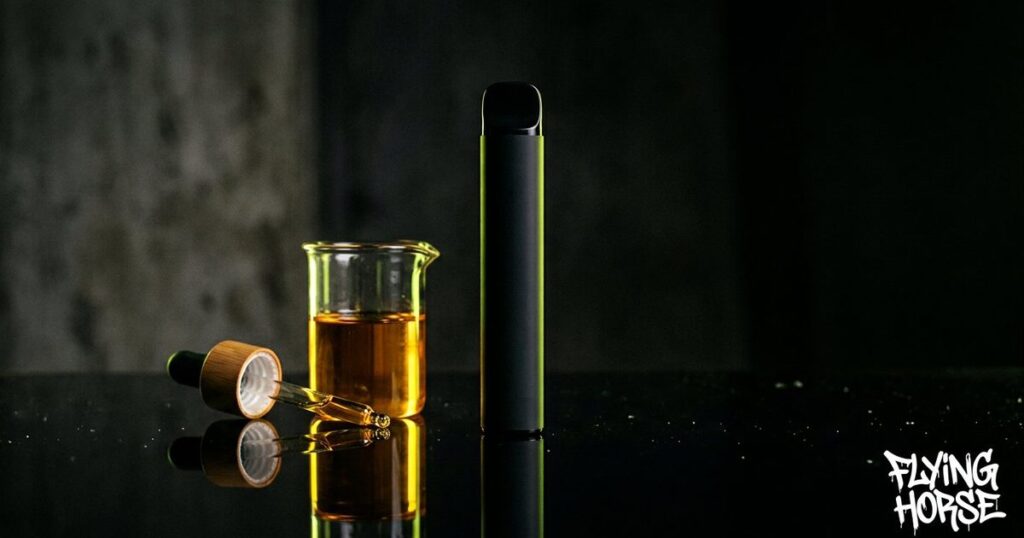
A THCP disposable looks like a pen and behaves like a small laboratory appliance. Understanding what’s actually inside explains why some pulls are smooth and others are harsh, why devices “die” at different times, and why quality varies so much between brands. Here’s the teardown.
The Three Core Components
- The distillate — the active payload. In our disposables, it’s THCP distillate: hemp-derived THC-P concentrated, with terpenes added back for flavor and smoothness. The liquid diamond line goes further — a crystalline fraction with higher clarity. Batch potency is published on the lab reports page.
- The coil — a small resistance wire that heats the distillate into vapor. Coil type (mesh vs. ceramic vs. standard wire) drives flavor fidelity and harshness. Mesh coils heat evenly and taste cleanest; cheap wire coils hot-spot and burn the concentrate — the #1 cause of the “tastes like burning cotton” experience on bad devices.
- The battery — typically 300–500mAh, draw-activated. Battery capacity sets the device’s practical lifespan, and its charging behavior sets how it dies (more on that below).
What Happens on a Pull
- The draw-activation sensor detects airflow.
- The battery drives current through the coil to ~200–250°C.
- Distillate wicks to the coil, vaporizes, and carries terpenes + cannabinoids into the airflow.
- A 2–3 second pull at that temperature produces a clean cloud; longer pulls overheat the wick and pull harsher, harsh-tasting vapor — which is why pull length is a dosing variable (vape dosing guide).
Why Devices “Die” Early (It’s Usually Not Distillate)
- Battery depletion — the most common “empty device.” Small batteries can be exhausted while visible distillate remains.
- Coil saturation/clogging — sugar-rich terpenes and thick distillate can block wicking; the device clicks but produces little vapor.
- Leakage — pressure changes (hot cars, planes) force distillate into the mouthpiece, fouling airflow. Storage matters (maintenance guide).
A 3.8g device like our Stoner Blend 3.8g typically yields weeks of evening sessions for a calibrated user; a 9g like the Stoner Blend 9g is measured in months. If your device underdelivers against that math, the support team will replace it under warranty.
Draw-Activation vs. Button Devices
Most disposables are draw-activated (no buttons) — convenient, but the activation threshold varies by device, which is why “it’s not hitting” can be a sensor issue before it’s a distillate issue. A firm, steady pull (not a sharp puff) reads better to the sensor than a hesitant one.
Quality Signals When Buying Any Disposable
- Published per-batch COA (potency + contaminants) — non-negotiable.
- Stated distillate weight that matches real-world longevity.
- Consistent pull-to-pull output (the coil’s job).
- A brand that replaces defective devices without drama.
That checklist is, frankly, a description of what our disposable line is built to pass. Flavor and hardware questions: the FAQ has the details.