
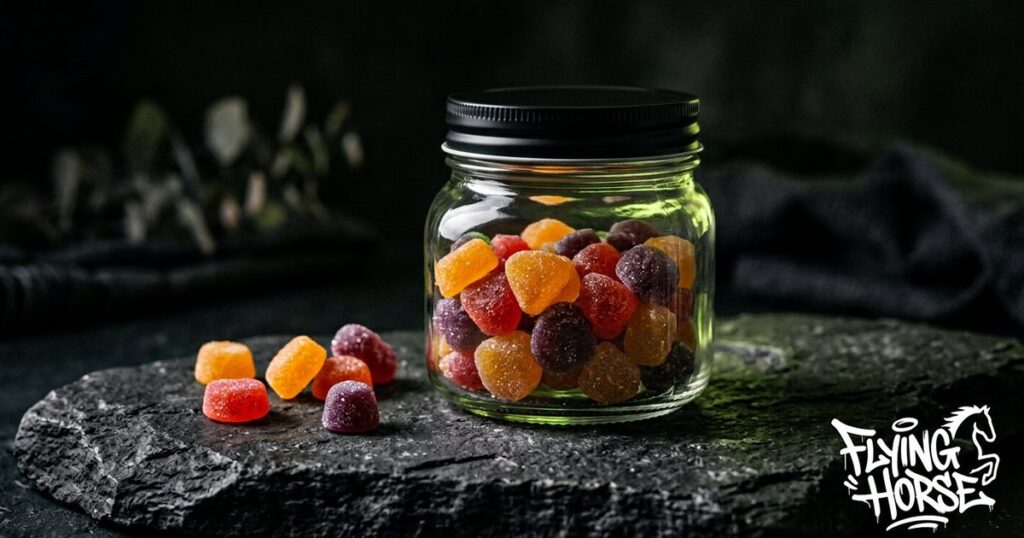
Home-infused edibles are a rite of passage in the cannabis world — and the format with the worst safety record, because the dosing math is unforgiving and nobody’s lab is testing your batch. If you’re considering making THCP edibles at home, read this before you light a stove.
The Dosing Math Problem
Store-bought gummies like our THCP Blend 15,000mg jar state 1,000mg per piece — a measured number with a batch COA behind it. At home, your “1,000mg gummy” is actually: (distillate potency × grams of distillate used ÷ number of pieces). Get any variable wrong and every piece is off — usually off by a lot.
- Distillate is typically 70–90% active cannabinoids. If you assume 100%, you’re under-dosing by a meaningful margin (or the reverse, if your concentrate is cut).
- A scale accurate to 0.1g is the minimum; 0.01g is better. Kitchen scales are not sufficient.
- Even distribution is the hard part — one thick brownie edge vs. one thin center can differ 2x.
The Decarboxylation Reality Check
THCA converts to active THCP-THC-type compounds with heat. With distillate, this step is less critical than with flower — most THCP distillate is already activated — but if you’re working with raw extract or flower, under-decarboxylation quietly produces a weaker product than you calculated. There’s no shortcut that’s been validated for THCP at home the way flower decarb times are for THC.
Contamination & Handling Risks
- Unverified material — the single biggest risk. Home cooks often use source-of-unknown concentrate. If the source isn’t lab-tested (the way every batch on our lab reports page is), you’re importing heavy-metal and solvent risk into your kitchen.
- Cross-contamination — dedicated utensils and pans. Cannabinoids stick to everything, and “leftover” pans become accidental dosers for the next cook.
- Labeling — every homemade edible gets a label: contents, dose estimate, date. Unlabeled edibles in a shared kitchen are a poisoning waiting to happen.
Child & Pet Safety (The Part That Actually Matters)
Homemade edibles are the leading cause of accidental cannabis edibles ingestions in children — because they look like regular treats and live in normal storage. If you make them: child-proof containers, high storage, never the normal candy jar, and tell every household member. For pets, the margin of safety is small; ingestion warrants an immediate call to a vet or poison line.
When Store-Bought Is the Better Call
- You want predictable dosing (that’s literally the point of a COA).
- You’re new to cannabinoids (calibration is easier with known numbers: dosing guide).
- Your state’s rules treat home-infused novel cannabinoids differently — check the state guide.
Our edibles line exists precisely so you don’t have to run the math, the lab, or the safety program yourself. Questions? The FAQ and support are the safe places to ask.